Tuesday, January 27, 2015

December Newsletter - Israeli ICT News


2014 was a great year for the Israeli technology, lots of significant deals and exits that define Israel as a world’s lead generator for advanced technology. In this month’s newsletter, we are bringing some of the highlights of this Year.


In the “Israeli ICT News” section, you can find a review about some of the main technology business news in Israel during 2014.

The “Topic of the month” section lists some of the innovative technologies that Vega BI offered during the year to the Brazilian market.


Moreover, we are using this opportunity to wish you all, a very good new year - 2015.


Sunday, January 25, 2015

Amazon to Acquire Israeli Chip Maker Annapurna Labs

Deal at $350 Million Discussed, but Price Could Rise to $375 Million
By  Orr Hirchanuge, The wall street journal

TEL AVIV— Amazon.com Inc. said it has agreed acquire secretive Israeli chip designer Annapurna Labs Ltd., a potential boost to its rapidly growing business that rents computing power to other companies.

An Amazon spokeswoman confirmed the deal after The Wall Street Journal and others reported on Thursday that the two companies were in advanced talks. She declined to disclose terms.
Annapurna wasn’t immediately available for comment.
Amazon had been discussing paying $350 million, according to two people familiar with the matter, though they said the price could rise to $375 million, depending on certain conditions.
Based in Yoqneam, in Israel’s north, Annapurna Labs was founded in 2011 by Avigdor Willenz, founder of the chip-design company Galileo Technologies Ltd.; Marvell Technology Group Ltd. bought Galileo for $2.7 billion in 2000.
Originally funded by Mr. Willenz and people related to him, Annapurna hasn’t revealed the technology it is developing. The people familiar with the matter said Annapurna develops midrange networking chips for data centers that transmit more data and use less power.
Seattle-based Amazon, a global market leader in cloud services and online retailing, likely would use Annapurna’s designs in its extensive data centers to lower operating costs.
Amazon Web Services rents computing power and data storage to more than one million businesses. Amazon doesn’t disclose revenue for the unit, but Piper Jaffray analyst Gene Munster estimates that it could post nearly $6 billion in revenue this year, up from $4.3 billion in 2014.

Tuesday, January 20, 2015

Brazilian IT services market grows 8.7 percent

Summary:Technology-based services continue to perform well even in a difficult year.
By Angelica Mari for Brazil Tech

The Brazilian IT services industry has seen an increase of 8.7 percent in the period between the second half of 2013 and the first half of 2014, according to numbers released by analyst IDC.

The increase in comparison to the numbers of the previous 12 months comes as something of a surprise, given that 2014 was far from a smooth year for the local industry.

"Considering the economic instability, the inflation, the late Carnival, the World Cup and the uncertainties prompted by the election, [the IT services market] performed well," says IDC Brazil senior analyst, Renato Rosa.

According to IDC, the rush to make up for the disruption caused by the holidays and the World Cup meant that suppliers worked on their sales pipelines a lot sooner than usual and also increased their investment in automation tools.

"The Brazilian services industry has been growing about three to four times above the GDP, which shows the willingness of players to meet client demands," Rosa adds.

"The market continues to force price reduction, as well as more agility and the delivery of fast and innovative projects."

Another conclusion of the IDC study is that the health and agribusiness sectors led the pack in terms of interest and level of maturity of IT services contracts.

Despite the difficulties of 2014, the analyst firm remains upbeat for the near future of the Brazilian IT services industry: "After a period of political uncertainty, we believe that [Brazil] will have a very promising period ahead," says Rosa.

But expectations for the Brazilian IT market overall have been reduced to 6 percent since 2012 compared to historic growth of 10 percent, according to separate research by local firm IT Data.

According to the analyst, IT spending in the corporate space in Brazil has also been hit by factors such as the increase in the US dollar value, which has in turn affected the purchasing of products and services.


"We are seeing a situation where Brazilian CIOs are fighting internally to avoid further reduction of their budgets and also trying to put more pressure than ever on vendors to get more value for money," says Ivair Rodrigues, research director at IT Data.

Sunday, January 18, 2015

Brazil tops banking malware list

Summary:Number of attacks peaks driven by attempts to steal money online during the World Cup.
By Angelica Mari for Brazil Tech 

Cybercriminals have placed Brazil as the number one nation in a online banking trojan ranking as attempts to steal cash online saw a massive increase during the World Cup.

New research by Kaspersky Lab covering the period from November 2013 to October 2014 lists Brazil as the country with the largest number of users attacked by banking malware, followed by Russia and Germany.

Some 299,830 users fell victim to banking malware in Brazil during the period. Second on the list is Russia with 251,917 attacked users and Germany, with 155,773 malware attacks in 2014.

The number of attacks grew considerably in the middle of 2014, surpassing 300,000 occurrences in May and reaching 350,000 in June. The average reported by Kaspersky Lab remained mostly below 250,000 attacks per month.

Reasons for the spike in malware attacks, according to the study, include online banking activity at the beginning of the holiday season as well as by the World Cup in Brazil – when cybercriminals used financial malware to steal tourists' payment data.

ZeuS remained the most widespread banking trojan in the world, while the Brazilian malware ChePro and Lohmys came second and third on the list.

Brazil has a thriving scene of cybercrime online "schools"offering training programs, according to a separate study on the country's digital underworld. One of the most sought-after types of "training" is how to perpetrate bank fraud, where cybercriminal wannabes learn the fraud workflow, then move on to how to use the tools needed to capture data.

Sunday, January 11, 2015

Israeli app gives sleep problems a rest

SleepRate uses a tried and true behavioral system to train users in habits that lead to more effective snoozing
By David Shamah, Start-up Israel


In a 24/7 world, sleep is increasingly becoming a luxury, to the great detriment of millions around the world. In the US alone one out of every three people will experience an extended period of insomnia at some point in their lives, impacting their health and costing the economy billions due to lost wages and productivity.

Now, an Israeli start-up called SleepRate has a solution that it says will help people sleep more efficiently and take maximal advantage of the hours they do have to sleep, even if they can’t get the full allotment recommended by experts.

Sleep deprivation is by far the most common ailment affecting Americans, according to the Centers for Disease Control – making it nothing short of an “epidemic.” The effects of lack of sleep is far more serious than walking around glassy-eyed, the CDC says. The body will not be denied; individuals who can’t sleep at night will end up falling asleep during the day, often at very inopportune moments. Unintentionally falling asleep, nodding off while driving, and having difficulty performing daily tasks because of sleepiness all may contribute to what has become a public safety and health crisis.

“Persons experiencing sleep insufficiency are also more likely to suffer from chronic diseases such as hypertension, diabetes, depression, and obesity, as well as from cancer, increased mortality, and reduced quality of life and productivity,” said the CDC.

Tuesday, December 23, 2014

12 hot application from Israel

Want to be better organized, make music with distant friends, avoid your ex, socialize your shopping experience? Israelis have made an app for that.
By Abigail Klein, Israel21C

Made-in-Israel mobile applications have been changing radically how we get from one place to another (Waze, GetTaxi); share videos and photos (Glide, for example), monitor our health; edu-tain our children and many other areas of our lives.
New apps are popping up all the time. Here are some of the newest blue-and-white apps for business and pleasure.


1. 24me
Forbes recently named 24me as one of “7 Great Apps to Simplify Your Life.” This iOS 8-ready app is touted as a next-generation personal assistant because it not only keeps you on top of your to-do list but also has cool features such as task-management and bill-paying components.
24me clip

2. Any.do
Any.do is a suite of integrated mobile productivity apps. Its original time-management app made the App Store’s “Best Apps of 2012″ list and also won Android’s Best App status. Now used by an estimated 10 million people, Any.do allows users to manage daily tasks through voice command or touchscreen. Any.do Moment prompts users to do a daily productivity ritual, while Cal assigns tasks to calendar events and merges to-do items with specific meetings. A reward feature lets users win prizes and coupons for completing tasks.Click here for more.
Any.do clip

3. VocalReferences
This Android and iOS app offers merchants a set of tools to capture, display and share video and text testimonials from customers to display on their website and on social media, among other platforms. VocalReferences is also available via Yahoo Commerce Central, the Yahoo Small Business Center and Yahoo’s Web Hosting product. Customers giving the testimonials can use the app to share feedback with friends.
VocalReferences clip 

Monday, December 15, 2014

November Newsletter – Internet Of Things (IoT)

Vega newsletter is published monthly by Vega BI, and distributed to our partners to facilitate pursuit of a common interest in top-notch technologies.
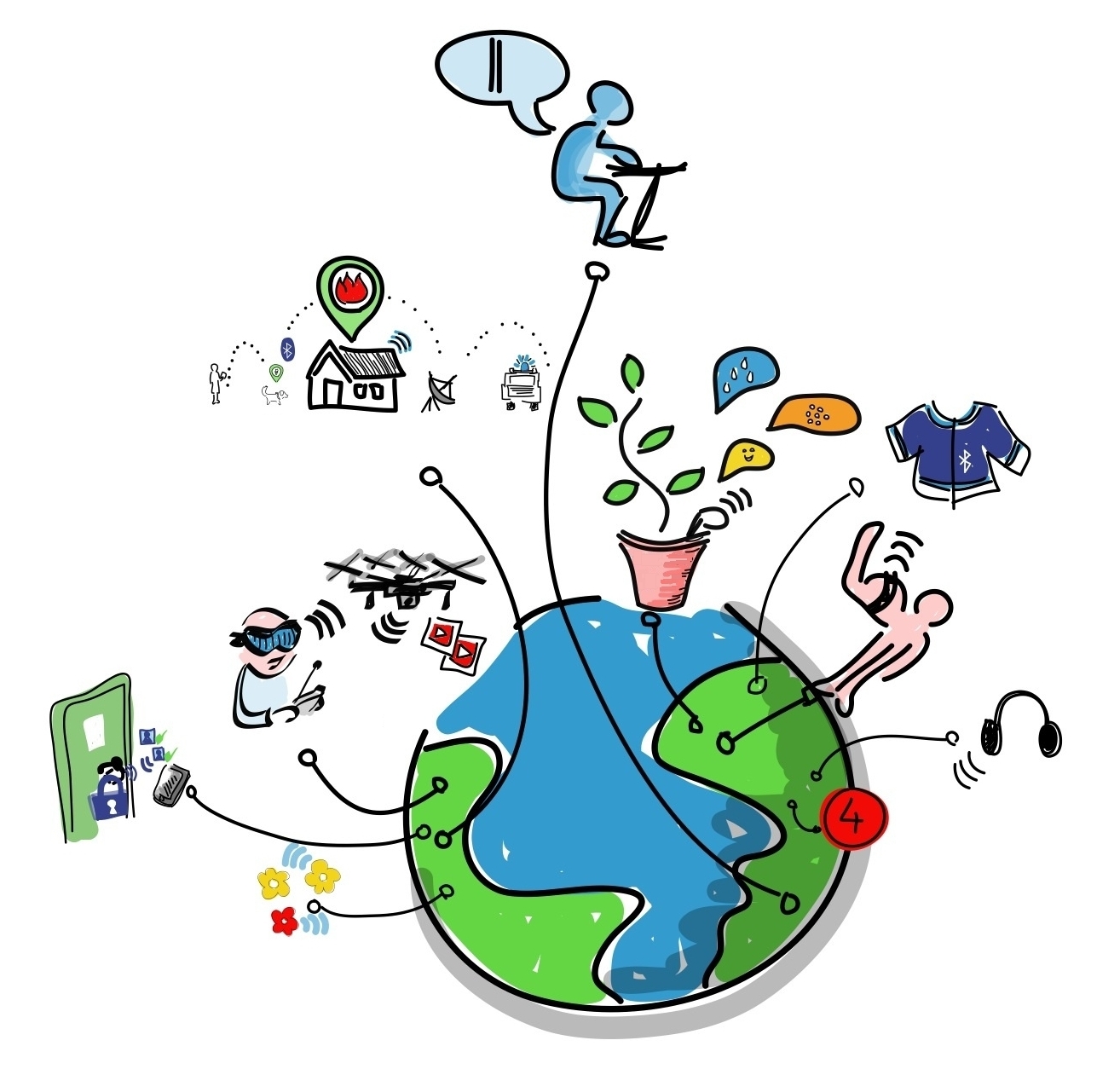
More objects are becoming embedded with sensors and gaining the ability to communicate. The resulting information networks promise to create new business models, improve business processes, and reduce costs and risks.


Introduction
The Internet of Things (IoT) is a scenario in which objects, animals or people are provided with unique identifiers and the ability to transfer data over a network without requiring human-to-human or human-to-computer interaction. IoT has evolved from the convergence of wireless technologies, micro-electromechanical systems (MEMS) and the Internet.

A thing, in the Internet of Things, can be a person with a heart monitor implant, a farm animal with a biochip transponder, an automobile that has built-in sensors to alert the driver when tire pressure is low - or any other natural or man-made object that can be assigned an IP address and provided with the ability to transfer data over a network. So far, the Internet of Things has been most closely associated with machine-to-machine (M2M) communication in manufacturing and power, oil and gas utilities. Products built with M2M communication capabilities are often referred to as being smart. (See: smart label, smart meter, smart grid sensor)

IPv6’s huge increase in address space is an important factor in the development of the Internet of Things. According to Steve Leibson, who identifies himself as “occasional docent at the Computer History Museum,” the address space expansion means that we could “assign an IPV6 address to every atom on the surface of the earth, and still have enough addresses left to do another 100+ earths.” In other words, humans could easily assign an IP address to every "thing" on the planet. An increase in the number of smart nodes, as well as the amount of upstream data the nodes generate, is expected to raise new concerns about data privacy, data sovereignty and security.

Although the concept wasn't named until 1999, the Internet of Things has been in development for decades. The first Internet appliance, for example, was a Coke machine at Carnegie Melon University in the early 1980s. The programmers could connect to the machine over the Internet, check the status of the machine and determine whether or not there would be a cold drink awaiting them, should they decide to make the trip down to the machine.

Kevin Ashton, cofounder and executive director of the Auto-ID Center at MIT, first mentioned the Internet of Things in a presentation he made to Procter & Gamble. Here’s how Ashton explains the potential of the Internet of Things:

“Today computers - and, therefore, the Internet - are almost wholly dependent on human beings for information. Nearly all of the roughly 50 petabytes (a petabyte is 1,024 terabytes) of data available on the Internet were first captured and created by human beings by typing, pressing a record button, taking a digital picture or scanning a bar code.

The problem is, people have limited time, attention and accuracy - all of which means they are not very good at capturing data about things in the real world. If we had computers that knew everything there was to know about things - using data they gathered without any help from us - we would be able to track and count everything and greatly reduce waste, loss and cost. We would know when things needed replacing, repairing or recalling and whether they were fresh or past their best.”